Overview
Shopify recently introduced a suite of new Return APIs, including the Exchange API, which allows merchants to programmatically manage returns, issue fees or refunds, and—critically—initiate exchanges directly within the original order thread. When integrated with Route Returns, this unlocks a cleaner operational and accounting process, giving merchants improved visibility and consolidated data handling for each order lifecycle.
This guide will walk you through:
- How the Exchange API works in the context of Route Returns
- The benefits of this approach
- Considerations and risks—especially for 3PL-integrated merchants
- How to get started
How the Exchange API Works with Route Returns
Route Returns now supports workflows that leverage the Shopify Exchange API to streamline the returns process. Here’s how it functions step by step:
- Return is Initiated on Route: A customer requests a return via the Route Returns portal.
-
Route Uses Shopify Exchange API:
- A new Return object is created for the original order.
- A Return Line Item is created for the item being returned.
- If an exchange is requested, Route specifies the new item(s) being sent in return.
- The API adds these new items to the original order as a new FulfillmentOrder, not a new Order.
-
Inventory and Fulfillment:
- The new item is now included in the original order's fulfillment timeline.
- A new
fulfillment_order_idis generated by Shopify for the exchange item(s).
- Route Sends Fulfillment Instructions to the fulfillment center (or 3PL), referencing the newly created FulfillmentOrder.
Benefits of Using the Exchange API
📊 Improved Accounting Reporting
By keeping everything tied to the original order, you avoid the creation of phantom or duplicate orders that can muddy accounting data. Financial events (refunds, exchange values, restocking fees) remain traceable within a single thread, simplifying:
- Revenue recognition
- Cost of goods sold
- Return and exchange metrics
This aligns with Route's Accounting Overview, where precise tracking of refunds, restocking fees, and return logistics is essential for accurate end-of-month reconciliation.
🧾 Concise Event History for Orders
Order histories are now centralized, reducing confusion in post-purchase support and customer service. A CSR (customer service rep) no longer needs to cross-reference multiple order numbers—they can see everything that’s happened with one order at a glance.
Risks and Key Considerations
⚠ Compatibility with 3PLs
The most significant risk is 3PL compatibility. Unlike standard orders, exchange items are added via new FulfillmentOrders on the original order, not as a new Order object.
Implication: Your 3PL must be able to read new FulfillmentOrders tied to existing orders.
Many legacy systems used by 3PLs expect only new Orders, so unless your warehouse or logistics partner is Shopify Fulfillment Network–compatible or otherwise modernized to read FulfillmentOrders, they may miss these new shipments.
🔄 Operational Workflow Alignment
Ensure that:
- Your warehouse management system (WMS) or 3PL is capable of monitoring
fulfillment_ordersvia the Shopify API. - Any custom apps or integrations that rely on Order creation are updated to handle FulfillmentOrder-based workflows.
If not, exchanged items may not be picked, packed, or shipped properly—leading to delays or inventory mismatches.
How to Enable the Exchange API
🛠 Step 1: Turn on the Exchanges Feature in Shopify
Go to the Feature Test Drives section in your Shopify Admin. You will see an entry titled "Exchanges". Click “Activate feature on stores”.
It should look like this:
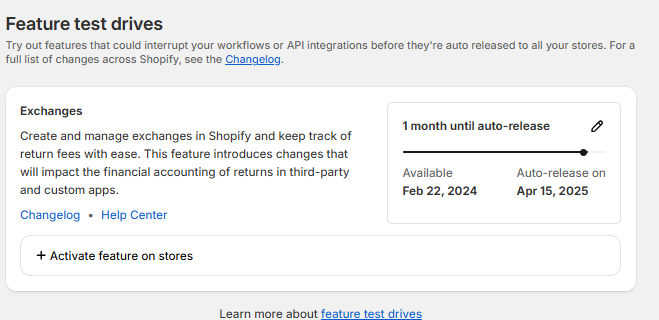
This feature is available as of Feb 22, 2024 and will auto-release in late 2025, but you can enable it early to take advantage of the benefits now.
🤝 Step 2: Contact Route Support
Once the Shopify feature is enabled, reach out to Route to activate Exchange API handling on your Route Returns account. This ensures that Frate will use the new exchange flow when processing return requests.
Conclusion
Using the Shopify Exchange API with Route Returns creates a unified, clean, and accurate returns system. The benefits to accounting and customer service are significant, especially for brands managing high return or exchange volumes.
Just make sure your operational stack—especially your fulfillment partner—is ready to handle FulfillmentOrders instead of relying solely on new orders.